

Before you plan 2027, discover what’s really driving your results.
You’ve worked hard to build your business.
You’ve earned the trust of your clients, developed your professional expertise, and achieved a level of success that many people aspire to.
From the outside, things look pretty good.
But how does success feel from the inside?
Are you experiencing the freedom, satisfaction, enthusiasm, and sense of accomplishment you imagined success would bring?
Or are you still struggling with some of the same frustrations that have followed you year after year?
Eight Frustrations That Success Doesn’t Necessarily Solve
As you reflect on 2026 and begin planning for 2027, consider whether any of these situations sound familiar.
Personal Success & Leadership
1. You’re successful, but you’re not feeling successful.
Your revenue may be increasing, your client base may be growing, and your business may look impressive on paper. Yet the satisfaction you expected from your accomplishments remains elusive. You wonder whether you’re building the business you truly want—or simply maintaining the one you’ve created.
2. You developed a business plan for 2026, but you didn’t stick with it.
You started the year with goals, priorities, and perhaps even a detailed strategic plan. Then everyday demands took over. Now, as the year draws to a close, you realize that many of your most important initiatives never received the attention they deserved.
3. Your time management is all over the place.
You understand the importance of prioritizing your time, yet your calendar is filled with interruptions, meetings, and activities that don’t necessarily move your business forward. You’re busy from morning until evening, but being busy and being productive aren’t the same thing.
Clients & Business Growth
4. You talk about qualifying clients, but you’re still serving everyone and anyone.
You know that not every prospective client is a good fit. You understand the importance of client segmentation and focusing your energy on relationships that are mutually rewarding. Yet you continue accepting and servicing clients who consume disproportionate amounts of your time and energy.
5. You’re not working with the clients you’d really love to work with.
When you began your career, you probably had a vision of the people you wanted to serve and the relationships you hoped to develop. Yet today, much of your time may be consumed by clients who don’t reflect that vision. You find yourself wondering how your business evolved so far from what you originally imagined.
Team Leadership & Performance
6. Your assistant is running you instead of supporting you.
You hired an assistant to create greater efficiency and free up your time. Yet somehow, you’re still reacting to their questions, interruptions, and priorities. Instead of having greater control over your working day, you sometimes feel that you’ve lost it.
7. You keep giving underperforming team members another chance.
You know certain team members aren’t consistently meeting their responsibilities. You’ve explained your expectations, offered support, and given them additional opportunities to improve. Yet little changes. Meanwhile, the situation continues to drain your time, energy, and enthusiasm—and may be affecting the morale of your stronger performers.
Hiring & Future Growth
8. You dread hiring another associate because your hiring process doesn’t work.
You recognize that your business needs additional people to grow. But previous hiring experiences have left you frustrated, disappointed, and reluctant to go through the process again. You’re concerned about investing more time, money, and emotional energy in another hiring decision that may not work out.
Here’s the Question I Would Like You to Consider
If you already know what needs to change, why do you continue experiencing the same frustrations?
After more than 30 years of coaching and consulting with financial advisors and agency owners, I’ve come to appreciate that many persistent business challenges aren’t simply the result of inadequate knowledge, poor planning, or insufficient effort.
Frequently, there is something deeper at work.
Your Business Is Influenced by More Than Your Business Decisions
As a Values & Behaviours analyst, I’ve seen how two equally intelligent, experienced, and successful advisors can approach the very same situation in remarkably different ways.
One advisor readily delegates responsibility. Another struggles to relinquish control.
One advisor comfortably declines business that doesn’t fit their ideal client profile. Another finds it difficult to say no.
One leader addresses underperformance promptly. Another avoids uncomfortable conversations and repeatedly gives people another chance.
Why?
Because our decisions are influenced not only by what we know, but also by our natural behavioural tendencies, the values that motivate us, and the emotional needs and beliefs we’ve developed throughout our lives.
Consider a few possibilities.
An advisor who continually takes responsibility for everything may have a strong need for control or may believe that nobody else will meet their standards.
A leader who avoids confronting underperformance may place tremendous importance on being liked, maintaining harmony, or avoiding rejection.
An advisor who accepts every prospective client may be motivated by the security of additional revenue—or by an underlying need for approval.
These aren’t diagnoses, and they aren’t necessarily weaknesses. They’re examples of how motivations and behavioural patterns can influence our decisions, sometimes without our conscious awareness.
And when those patterns operate outside our awareness, we can continue repeating behaviours that undermine the very results we’re working so hard to achieve.
From Greater Awareness to Meaningful Change
Understanding what drives our behaviour is an important beginning. But awareness alone doesn’t transform a business.
The real opportunity comes when greater self-awareness is combined with stronger leadership, effective systems, clear accountability, and consistent implementation.
This is where my approach to personal and business coaching, Values & Behaviours analysis, and Fractional Chief Operating Officer services comes together.
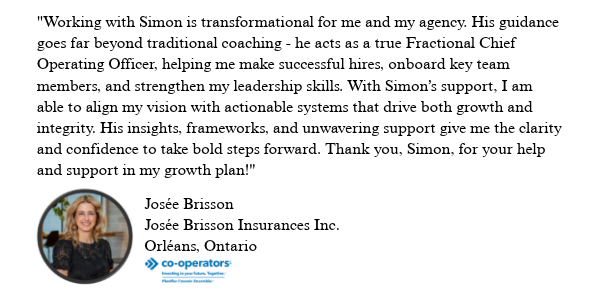
As Josée Brisson, a Co-operators agency owner in Orléans, Ontario, describes her experience:
The important distinction is that meaningful change requires more than identifying what isn’t working.
It requires understanding why familiar patterns persist and then developing the leadership capabilities, people, systems, and accountability needed to create different results.
What If the Problem Isn’t Your Plan?
Think about the business plan you developed for 2026.
Perhaps it contained excellent goals, sensible strategies, and well-considered priorities.
But did your daily behaviour support those priorities?
Or did you continually allow the urgent to displace the important?
Did you delegate responsibilities—or continue taking them back?
Did you make difficult personnel decisions—or postpone them?
Did you focus on your ideal clients—or continue accommodating everyone?
A business plan can tell you what you intend to accomplish.
But understanding your values, behaviours, beliefs, and unmet needs can help you recognize what may be preventing you from accomplishing it.
That understanding can be the beginning of a very different approach to business planning.
Before You Plan 2027, Try This Exercise
Rather than beginning with your revenue targets, sales objectives, and growth projections, I invite you to consider three questions.
1. What frustration has followed me from year to year?
Identify one recurring situation that continues to consume your time, energy, or enthusiasm.
2. What might be driving my response to this situation?
Is there a need for control, security, approval, recognition, certainty, or something else influencing your decisions?
Don’t assume the first explanation is the correct one. Become curious about your own behaviour.
3. What could become possible if I changed my response?
Imagine how your business and personal life might improve if you were no longer responding to that situation in the same familiar way.
You might discover that the change you need in 2027 isn’t another strategy, system, or set of goals.
It may begin with greater awareness of yourself.
A Different Approach to 2027
Business success is important. So are profitability, growth, productivity, and financial security.
But I believe success should also provide something more.
Greater freedom. More meaningful relationships. Renewed enthusiasm. The satisfaction of working with clients you genuinely enjoy serving. And the ability to lead a business rather than continually being consumed by it.
Over the coming weeks, I’ll be sharing a series of articles exploring how inspiration, values, behaviours, leadership, team performance, and practical business strategies can help financial advisors and agency owners approach 2027 differently.
We’ll examine why familiar challenges persist, what may be driving them, and how greater awareness can translate into meaningful change.
Because perhaps the most important question isn’t simply:
What do I want to accomplish in 2027?
It’s:
What’s preventing me from experiencing the success I’ve already worked so hard to achieve?
Simon Reilly
Leadership & Business Growth Advisor
Personal & Business Coach | Values & Behaviors Analyst | Fractional COO
Founder, Leading Advisor Inc.