
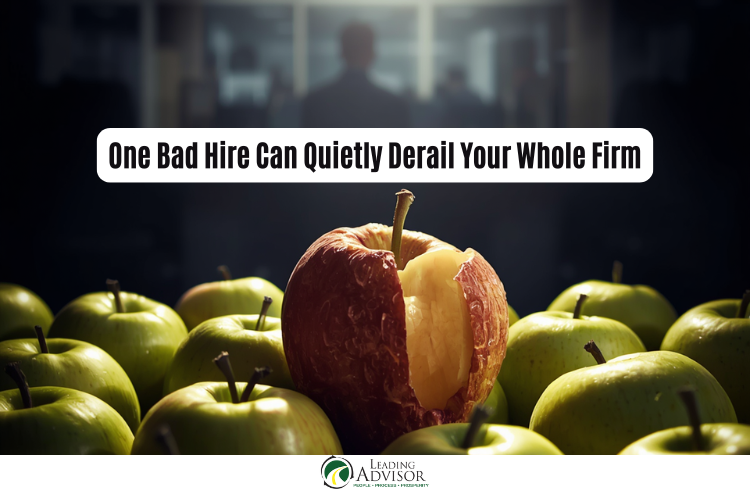
Every leader knows the financial cost of a bad hire.
The lost time.
The training.
The rework.
The missed opportunities.
The eventual replacement.
But the real cost of a bad hire isn’t financial.
It’s emotional.
It’s cultural.
It’s structural.
It’s energetic.
And it often takes months — sometimes years — for founders to see the full impact.
Because a bad hire rarely announces themselves dramatically.
More often, they slip into the business quietly, unnoticed at first… until the effects begin to surface in ways no one expected.
Leaders tell me the same thing almost every time:
“It wasn’t that they were a terrible person… something just never clicked.”
“They had potential, but they drained the team.”
“Small issues turned into big problems.”
“I found myself managing their attitude more than their work.”
“I didn’t realize how much they were holding us back until they left.”
Because here’s the truth:
A bad hire doesn’t damage your business in one moment.
They damage it in a thousand small moments.
Their impact shows up in subtle but powerful ways:
1. They dilute the culture.
People lower their standards to accommodate them.
They normalize the behavior around them.
The energy in the office changes — often without you noticing until it’s too late.
2. They create emotional drag.
You think about them on the weekend.
You brace yourself before conversations.
You walk into the office wondering what new issue will surface.
Leadership becomes management — and management becomes babysitting.
3. They slow down your best people.
Top performers start compensating for their gaps.
Team members cover for them.
Deadlines become group efforts instead of shared ownership.
4. They undermine trust.
Not overtly — but through inconsistency, excuses, or unpredictable behavior.
People stop assuming clarity.
They start assuming chaos.
5. They drain the leader’s energy.
You spend emotional bandwidth that should go toward strategy, growth, and leadership — not containment.
6. They distort accountability.
The team becomes confused about expectations.
Fairness becomes unclear.
The standards blur.
And perhaps the most damaging effect:
7. They shape your future hiring decisions.
A bad experience makes leaders hesitant to hire again, even when the business desperately needs capacity.
You start avoiding growth because you fear repeating the same mistake.
This is the real cost.
Not the salary.
Not the training.
Not the lost months.
It’s the emotional residue left behind.
Because a bad hire doesn’t just slow your business.
They change it.
And the hardest part?
It often has nothing to do with their résumé —
and everything to do with their behavior, values, and motivators.
This is why traditional hiring fails so often in advisory firms.
Skills don’t reveal:
- how someone handles pressure
- how they communicate under stress
- how they respond to accountability
- how they align with your values
- how they show up when things get hard
- how motivated they are by the actual responsibilities
- how they fit the psychology of your culture
But behavior does.
Values do.
Motivators do.
This is why I always remind founders:
A good hire strengthens the entire firm.
A bad hire weakens it quietly.
The solution is not hiring slower.
It’s hiring smarter.
It’s hiring with behavioral clarity.
It’s hiring with value alignment.
It’s hiring with future growth in mind, not present panic.
Because when you hire the right person — someone aligned, grounded, eager, and capable — the opposite happens:
The team rises.
The culture strengthens.
The systems stabilize.
The leader feels supported.
And the business accelerates almost effortlessly.
That is the true ROI of the right hire.
The Invitation
If this Insight speaks to you, I invite you to explore a resource designed to prevent costly hiring mistakes before they happen:
👉 The Inner Compass Leadership Diagnostic
A powerful tool for understanding the behavioral and values alignment required for healthy hiring — starting with the leader’s own psychology.
👉 Click here to schedule a complimentary conversation with me.
Together, we’ll ensure your next hire strengthens, rather than quietly derails, your firm.