
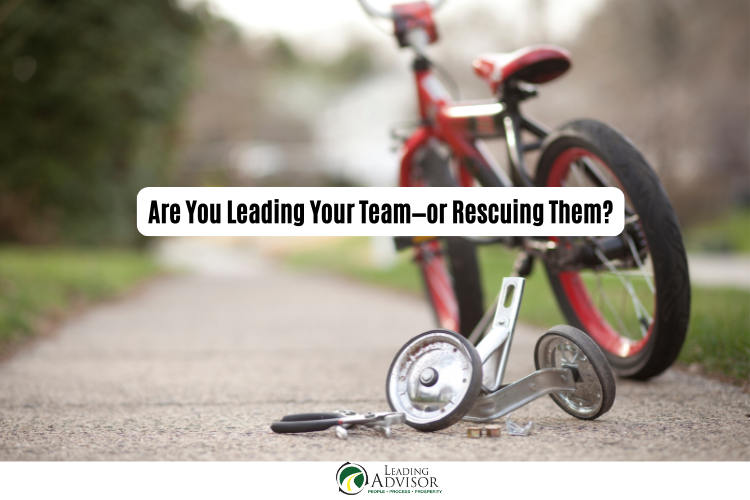
There is a leadership habit that looks like caring, feels like helping, and can quietly undermine the very team you’re trying to build.
It’s rescuing.
And I’ve seen it happen with some of the most committed financial advisory firm owners and insurance agency leaders.
An employee encounters a problem.
They come to you for help.
You provide the answer.
The problem gets resolved, everyone moves forward, and you feel good about having supported your team.
Nothing wrong with that, right?
Not necessarily.
But what happens when the same employee returns tomorrow with another problem? And the following day? And the week after that?
At some point, you have to ask yourself an important question:
Am I developing this person’s ability to succeed, or am I teaching them to depend on me?
That distinction can determine whether your agency becomes a business that grows through its people—or one that can only grow through your continued personal involvement.
When Good Intentions Create the Wrong Results
Most agency owners don’t deliberately create dependent teams.
Quite the opposite.
They care deeply about their employees. They want people to succeed, feel supported, and enjoy coming to work.
Many have invested significant time and resources into building a positive culture.
And when an employee struggles, their natural instinct is to help.
The challenge is that helping can gradually become over-functioning.
You start answering questions employees should be capable of answering themselves.
You take over difficult client situations instead of coaching someone through them.
You make decisions that properly belong to another role.
You accommodate repeated performance shortcomings because you recognize someone’s effort and good intentions.
Over time, a subtle but important change occurs.
The employee becomes increasingly comfortable bringing problems to you.
And you become increasingly responsible for solving them.
What started as a supportive relationship gradually becomes a dependency.
The employee may feel cared for, but they aren’t necessarily becoming more capable.
Meanwhile, your workload continues to increase.
The Difference Between Caring and Carrying
One of the most important leadership distinctions I encourage agency owners to understand is this:
You can care deeply about someone without carrying responsibilities that belong to them.
Caring means providing people with the training, resources, encouragement, feedback, and opportunities they need to succeed.
Carrying means assuming responsibility for their decisions, problems, performance, or emotional reactions.
The difference is significant.
When you care, you help someone develop.
When you carry, you may unintentionally prevent that development.
Consider an insurance service advisor who repeatedly approaches the agency owner with questions about how to handle client requests.
Initially, the owner explains the process.
But months later, the same types of questions continue.
The owner may conclude that the employee simply needs more support.
Perhaps.
But another possibility deserves consideration.
Has the employee ever been expected to think through the situation independently before requesting assistance?
Has the owner clearly established which decisions the employee is authorized to make?
Has the employee been held accountable for developing the required judgment?
Without those expectations, the owner may be reinforcing the very behaviour they want to change.
The Leadership Shift: From Fixing to Coaching
The solution isn’t to become less approachable.
It’s to become more intentional about how you respond.
When someone brings you a problem, resist the temptation to immediately provide the answer.
Instead, ask:
“What do you think the next step should be?”
“What options have you considered?”
“How would you approach this if I wasn’t available?”
“What do you need from me to move forward?”
These are simple questions.
But they change the relationship.
Instead of being the source of every solution, you become someone who helps employees develop their own problem-solving capabilities.
And something else happens.
You begin discovering who is capable of taking greater ownership.
Some employees respond exceptionally well when given the opportunity to think independently.
Others may need additional training, clearer expectations, or more structured coaching.
And occasionally, you’ll discover that someone is not well suited to the responsibilities of their position.
That’s valuable information too.
Why Rewarding Effort Isn’t Always Enough
Another pattern worth examining is how agency owners recognize employee performance.
Many leaders are naturally generous.
They appreciate employees who work hard, maintain a positive attitude, and demonstrate loyalty.
Those qualities matter.
But they cannot replace measurable results.
An employee may be trying very hard while consistently failing to meet the expectations of the role.
If the owner continually rewards effort without addressing outcomes, an unintended message emerges:
Good intentions are sufficient.
In a growing advisory or insurance business, that creates problems.
Client service standards must be maintained.
Sales and relationship development responsibilities must be fulfilled.
Administrative work must be completed accurately.
And every team member must understand what successful performance looks like.
This doesn’t mean disregarding effort.
It means recognizing that effort and results are two different dimensions of performance.
Strong leadership acknowledges both.
Accountability Is a Form of Respect
Some leaders hesitate to establish firm expectations because they worry about damaging relationships.
But consider the alternative.
An employee works for months without clearly understanding what success requires.
The owner becomes increasingly frustrated.
Performance concerns accumulate.
Eventually, a difficult conversation occurs that could have been avoided much earlier.
Who benefits from that arrangement?
Nobody.
Clear expectations actually create a more respectful working relationship.
People understand their responsibilities.
They know how their performance will be evaluated.
They receive feedback before small problems become serious ones.
And they have a fair opportunity to improve.
This is particularly important during onboarding.
A new employee should understand not only what tasks they’ll perform, but what outcomes they are expected to produce.
If a position includes both client service and business development, define that balance.
If prospecting is required, establish expectations.
If independent decision-making is part of the role, explain the boundaries of that authority.
Don’t wait until frustration develops to introduce accountability.
Build it into the relationship from the beginning.
The Owner’s Responsibility Is to Build Capability
As your agency grows, your leadership responsibilities change.
Early in your career, your success may have depended heavily on your ability to personally solve problems.
You became the person clients trusted.
The person who knew the answers.
The person who could step into almost any situation and make things happen.
Those capabilities helped build the business.
But they can also become a limitation.
Because a growing organization cannot depend indefinitely on one person’s judgment, energy, and availability.
At some point, your role must evolve.
Instead of being the person who solves every problem, you become the leader who develops people capable of solving problems.
Instead of personally maintaining every standard, you create systems that reinforce those standards.
Instead of carrying the team’s responsibilities, you establish clear ownership and accountability.
That’s the difference between managing activity and building organizational capacity.
Final Reflection
If you’re feeling overwhelmed by the number of questions, interruptions, and problems that come across your desk each day, consider whether your leadership approach may be contributing to the pattern.
Ask yourself:
Where am I solving problems my team should be learning to solve?
Where am I rewarding effort without adequately evaluating results?
And where might my desire to be supportive be preventing someone from developing greater independence?
You don’t have to become less caring to become a stronger leader.
You need to become more intentional about what genuine support looks like.
Because the ultimate measure of your leadership isn’t how many problems you personally resolve.
It’s how capable your team becomes because of the way you lead.
Enjoy insights like these?
Subscribe to Weekly Strategic Insights for practical perspectives on leadership, team accountability, and building a stronger financial advisory or insurance agency.